About Matthews NC Water Damage Restoration
24/7 water damage restoration for Matthews and nearby Mecklenburg and Union County towns: extraction, structural drying and sewage cleanup, documented from the first reading.
Restoration built around how water behaves in a Piedmont depot town
Matthews NC Water Damage Restoration covers water damage and sewage cleanup for Matthews and the towns around it, from the railroad-era blocks along Trade Street and John Street to the subdivisions off Sardis Road, Matthews-Mint Hill Road and the Union County side of 28104. The restoration team extracts standing water, removes what cannot be saved and dries the structure to the IICRC S500 standard.
Water here has a pattern. Most older homes sit on vented crawl spaces over red clay that drains slowly, and more of them now depend on a crawl space sump pump. Tropical storm remnants arrive late in the summer and fill Four Mile Creek. Houses from the late 1970s into the mid 1990s often carry polybutylene supply lines, and a few hard freezes each winter catch pipes that were never protected. The local water damage experts plan every dry-out around those conditions.
Every job follows the same order: moisture mapping before any equipment goes down, extraction, drying sized to the class of the loss and daily readings until wet materials match a dry reference. The file that results goes to you and your insurer.
Find us on Google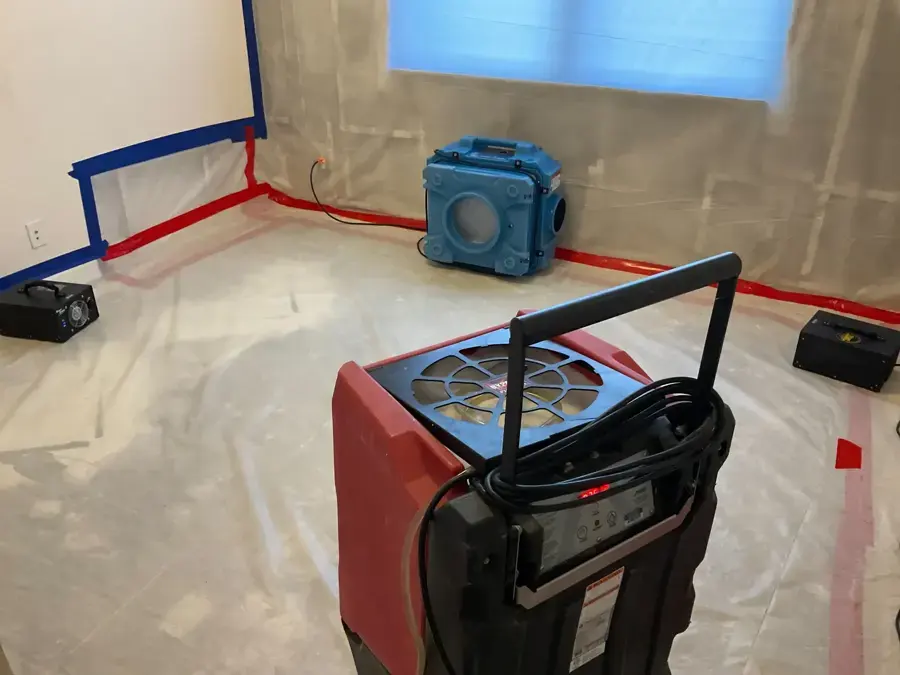
How every Matthews water loss is handled
- 01
Moisture mapping
The tech who does the walkthrough maps wet materials with pinless meters and thermal imaging before any equipment goes down.
- 02
Extraction
The extraction crew pulls standing water with truck-mounted units, so it leaves the building instead of moving to the next room.
- 03
Air movers and LGR
The drying team sets air movers to each room's evaporation load and LGR dehumidifiers to pull that water back out of the air.
- 04
Readings to dry
Readings are logged daily, and equipment comes out only when wet materials sit within 2 to 4 points of a dry reference.
What the drying standard means in practice
Category decides removal
Category 1, 2 and 3 water are handled differently, and porous materials touched by Category 3 water are removed, not dried.
Class decides equipment
Class 1 through 4 sets how many air movers and dehumidifiers a room needs, and whether desiccants join the LGR units.
Readings decide done
Equipment leaves when wet materials are within 2 to 4 points of a dry reference in the same building.
Water damage in Matthews? The restoration team answers 24/7.
Extraction, crawl space drying and sewage cleanup across Matthews and nearby towns, documented for your insurance claim.